





Choosing a two-way radio used to be simple: pick a handheld, charge it and start talking. Today there is a second option, and it matters. A DMR radio brings digital audio, longer battery life and smarter calling features, while a traditional analog radio is still the cheapest and simplest way to keep a team connected.
This guide compares the two so you can decide which suits your site, your team size and your budget.
What is an analog two-way radio?
Analog radios send your voice as a continuous radio wave. This is the technology behind most walkie talkies sold in India, from the entry-level BF-888S to the popular UV-5R family.
It is simple and dependable. Anyone can pick one up, press the push-to-talk button and speak. Any analog radio on the same frequency can hear you, which is also its limitation.
What is a DMR radio?
DMR stands for Digital Mobile Radio, an open digital standard (ETSI) designed for professional and commercial communication. A DMR radio converts your voice into digital data before transmitting it, and the receiving radio converts it back to speech.
DMR uses TDMA, which splits one channel into two time slots. This lets two separate conversations share one frequency, and it helps stretch battery life because the radio transmits only during its own slot.
Many DMR handhelds, including several Baofeng models, are dual mode. They work in both digital and analog, so you can upgrade gradually without replacing every radio at once.
DMR vs analog: side-by-side comparison
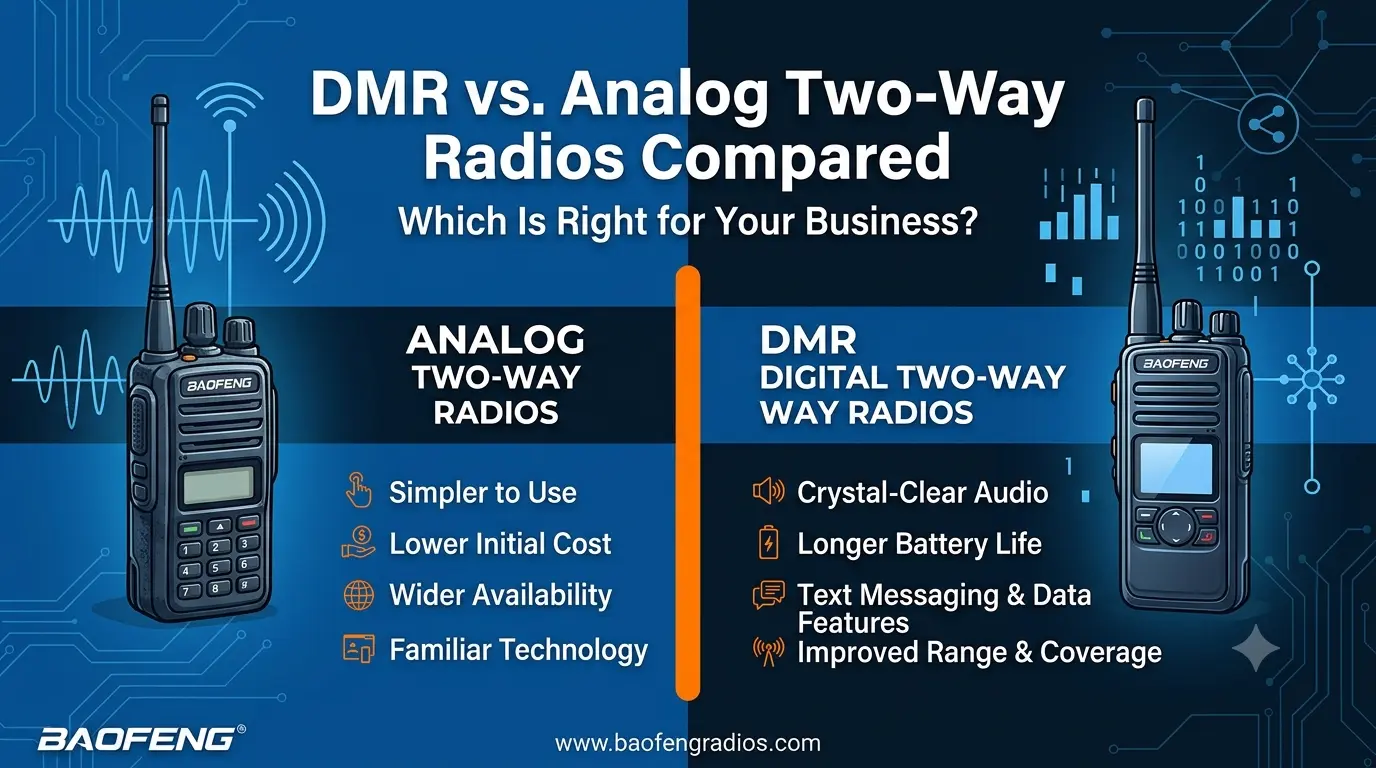
Feature | Analog radio | DMR radio |
Audio quality | Gets noisier and weaker with distance | Stays clear until the edge of coverage, with background noise filtered out |
Range behaviour | Gradual fade into static | Clean audio, then a sharper drop-off at the limit |
Battery life | Standard | Generally longer in digital mode, thanks to TDMA |
Capacity | One conversation per channel | Two simultaneous conversations per channel |
Calling features | Group talk only | Group calls, private calls, all-call and text messaging |
Privacy | Anyone on your frequency can listen | Digital signal is harder to overhear, with optional encryption on supported equipment |
Programming | Simple | More involved (contacts, colour codes, talk groups) |
Cost | Low | Higher upfront |
Compatibility | Works with other analog radios | Dual-mode DMR radios can also talk to analog radios |
Audio quality and range
This is the biggest practical difference.
An analog signal weakens gradually as you move away from the other radio. You hear more hiss and crackle, but you can often still make out the words.
A DMR radio uses error correction, so voice stays clear and consistent until the signal is nearly gone. Warehouses, factories, construction sites and busy event venues are all noisy environments where this matters. Digital processing separates your voice from the background noise, so instructions are understood the first time.
Range itself depends mostly on power, antenna, terrain and obstructions rather than on digital versus analog. Don’t expect a DMR radio to magically cover more distance than an analog radio of the same power.
Battery life
Because DMR transmits in time slots, the radio is effectively transmitting only half the time. In real-world use, that usually means more hours per charge than a comparable analog radio. For security guards, event crews or hospitality teams working long shifts, this reduces mid-shift battery swaps.
Features that help teams work smarter
Analog radios do one thing well: voice. A DMR radio adds tools that make larger teams more organised:
Group calls: speak to your whole department, or only the people who need to hear you
Private calls: one-to-one conversations without interrupting everyone else
All-call: broadcast urgent messages to every radio
Text messaging: send short written messages when voice isn’t practical
Better channel use: two time slots on one frequency
Exact features vary by model, so check the product page for the radio you are considering.
Privacy and security
Analog transmissions can be heard by anyone tuned to the same frequency with a compatible radio. For hotels, retail stores and security teams, that may be fine. For businesses discussing operations, schedules or sensitive information, digital transmission offers a meaningful step up, and supported DMR equipment can add encryption.
Cost: analog still wins on price
On the Baofeng India store, popular analog models sit at the lower price points. For example, the BF-888S starts from around ₹1,549, and the UV-5R from around ₹3,699. Baofeng’s DMR models are priced higher, in the range of roughly ₹17,000 to ₹20,000 per radio (current listings include the DM-1701, DR-1801UV and DM-32). Prices change, so check the product pages for current offers.
For a small team that mainly needs reliable voice, analog is often all you need. If you are managing a larger team or a busy site, the extra cost of DMR can be repaid in clearer communication and better organisation.
A note on licensing in India
Licensing depends on the frequency band, not on whether the radio is analog or digital. Licence-free walkie talkies operate on the permitted licence-free band, while radios operating on licensed VHF/UHF frequencies need the appropriate approval from the relevant authority (WPC). Check the current rules before you buy and before you transmit. We cover this in more detail in our guide to licence-free vs licensed walkie talkies.
Which should you choose?
Choose analog if:
You have a small team (a handful of radios)
Your needs are basic voice communication
Budget is the priority
Your site is small, such as a shop, restaurant, school or small office
Choose a DMR radio if:
You manage a larger team or multiple departments
You work in noisy environments
Your staff work long shifts and battery life matters
You want private calls, group calls or messaging
Privacy matters more to you
You want to plan for growth
Not sure? Choose dual-mode. A DMR radio that also works in analog mode, such as the Baofeng DM-1701, lets you keep using existing analog radios while you move your team to digital over time.
Popular DMR radios from Baofeng
Baofeng DM-1701: dual-band digital and analog handheld, a good entry point into DMR
Baofeng DR-1801UV: 5W dual-band DMR walkie talkie
Baofeng DM-32: high-power dual-band digital handheld for demanding use
Browse our full range of Baofeng business handheld radios to compare models, or contact our team at +91 70118 31918 if you need help choosing.
FAQs
Is a DMR radio better than an analog radio?
Not always. A DMR radio gives clearer audio, longer battery life and more features, but analog is cheaper and simpler. The better choice depends on your team size, environment and budget.
Can a DMR radio talk to an analog radio?
Only if it is a dual-mode DMR radio, which can switch between digital and analog. A digital-only radio cannot communicate with an analog radio.
Does a DMR radio have a longer range than analog?
Not by itself. Range depends on power, antenna, terrain and obstacles. DMR mainly improves how clear the audio stays across that range.
Do I need a licence to use a DMR radio in India?
That depends on the frequency you use. Radios operating on licensed bands need the appropriate approval, while licence-free bands do not. Check current WPC rules before use.
Is DMR worth it for a small business?
For a shop or small office, analog is usually enough. DMR becomes worthwhile as teams grow, sites get noisier, or privacy and organised calling become important.